
RELEASE DATE - 2026.01.02
In modern high-precision industrial environments, vibration control is no longer a secondary consideration—it is a critical factor that directly affects system stability, operational accuracy, and long-term equipment reliability.
For server racks, semiconductor manufacturing equipment, precision inspection systems, and automation platforms, even minor ground-borne vibrations can accumulate over time, leading to alignment drift, signal interference, increased wear, or unexpected downtime.
At TAI SAM HARDWARE, we work closely with equipment manufacturers and system integrators who face these vibration-related challenges in real-world applications. Through years of experience supplying industrial hardware for servers, semiconductor tools, and precision machinery, we understand that mobility solutions must go beyond basic movement. This article draws on that practical insight to explain how shock absorbing caster technology works, and how selecting the right ultra-low vibration solution can significantly improve equipment stability, reliability, and long-term performance.
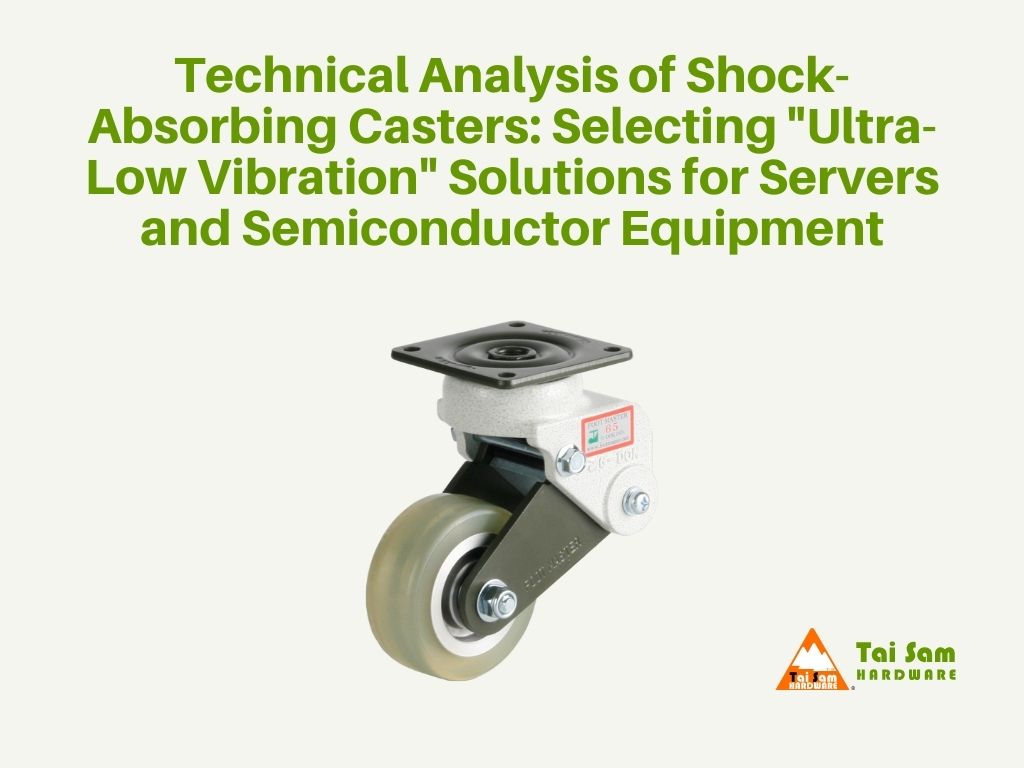
A shock absorbing caster is not simply a “softer wheel.” It integrates elastic damping mechanisms—such as springs, elastomer modules, or vibration-isolating structures—designed to absorb and dissipate energy before it reaches the equipment frame.
Key differences from standard casters include:
High-quality shock absorbing casters utilize controlled vertical deflection under load, converting vibration energy into elastic deformation rather than transmitting it upward.
Shock absorption is only effective when the caster operates within its designed load range. Underloading or overloading reduces damping efficiency and may compromise stability.
When selecting shock absorbing casters for servers or semiconductor equipment, consider the following:
TAI SAM HARDWARE’s shock absorbing caster series is engineered specifically for industrial-grade and high-precision applications, offering:
Product series: TAI SAM Shock Absorbing Casters
| Feature | Shock Absorbing Casters | Standard Industrial Casters |
|---|---|---|
| Vibration Isolation | Excellent – reduces low and mid-frequency vibration | Minimal – vibration directly transmitted |
| Structural Design | Integrated damping or elastic suspension | Rigid structure |
| Equipment Protection | High – protects sensitive components | Limited |
| Long-Term Stability | Designed for continuous static load | Depends on floor conditions |
| Noise Reduction | Significantly reduced operational noise | Noise amplification possible |
| Suitable for Precision Equipment | Yes | Not recommended |
Rubber wheels primarily improve rolling smoothness, while shock absorbing casters actively isolate vibration through internal damping structures.
No, when properly selected. Effective designs provide controlled deflection within a defined load range, maintaining stability while absorbing vibration.
For optimal performance, actual load should typically fall within 70–85% of the caster’s rated capacity.
Yes. High-quality casters are designed for long-term static loads without material fatigue when used within specifications.
Yes. This approach allows easy positioning with casters, followed by final stabilization using leveling feet.
For servers, semiconductor equipment, and precision industrial systems, vibration control is a fundamental requirement—not an optional upgrade.
By selecting the right shock absorbing casters, engineers can significantly reduce vibration transmission, protect sensitive components, and improve overall system reliability. Choosing the right shock-absorbing caster is not just about making equipment “moveable”—it is about ensuring optimal performance during operation.
TAI SAM HARDWARE delivers industrial solutions designed to meet the demands of ultra-low vibration environments. Through careful load matching, robust structural design, and application-focused engineering, our products help ensure stable, quiet, and reliable equipment operation.
Contact us today to request technical support, samples, or customized specifications.



This site uses cookies to improve your browsing experience. we’ll assume you’re OK to continue. If you want to read more about this, please click PRIVACY thank you.