RELEASE DATE - 2026.04.09
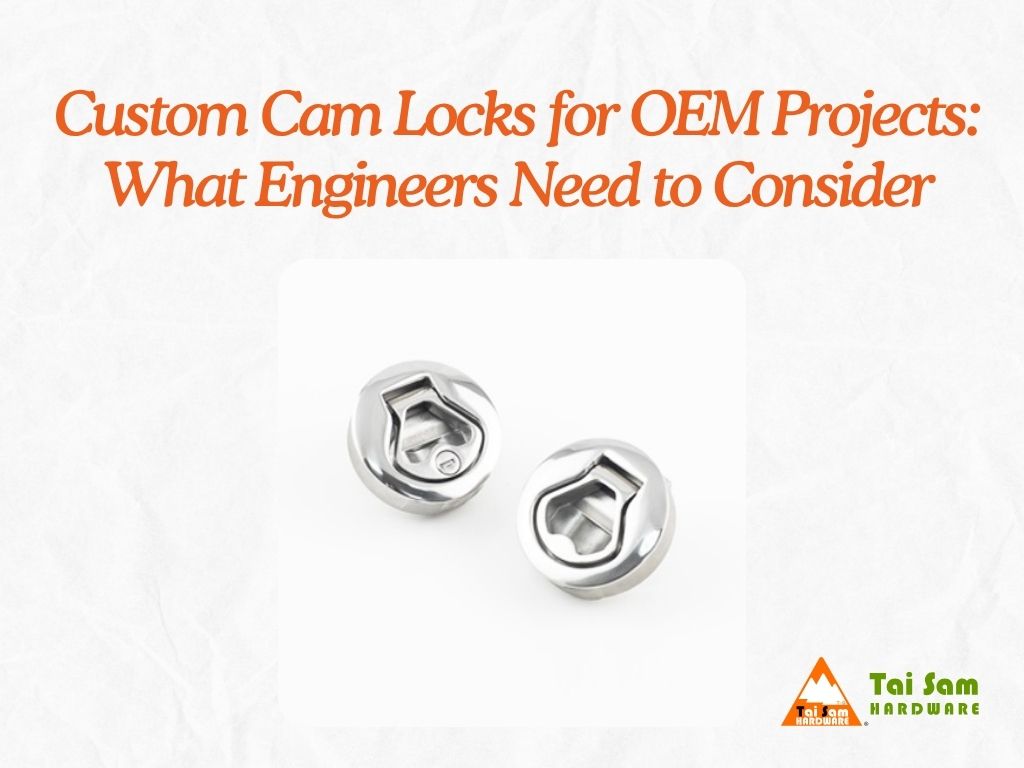
In industrial equipment design, locking components are often underestimated. However, in reality, they play a vital role in ensuring security, structural integrity, environmental protection, and user experience. Among various locking mechanisms, cam locks remain one of the most widely adopted solutions due to their compact structure, simple operation, and cost efficiency.
While standard cam locks may be suitable for general applications, OEM projects often involve unique design constraints—such as non-standard panel thickness, harsh environmental conditions, specific security levels, and customized user interaction requirements. In such cases, relying on off-the-shelf products may lead to compromised performance or integration challenges.
At TAI SAM HARDWARE CO., LTD., we collaborate with OEM clients across industries including industrial machinery, electrical enclosures, transportation systems, and energy infrastructure. Based on real-world engineering experience, this guide outlines the key technical factors to consider when developing custom cam lock solutions.
One of the most critical yet frequently overlooked aspects is the relationship between panel thickness and cam engagement geometry.
Engineers must evaluate:
A mismatch can result in:
Custom cam designs such as straight cams, offset cams, and multi-step cams allow precise adaptation to various enclosure structures.
The choice of material directly affects durability, corrosion resistance, and lifecycle performance.
Common material options include:
For applications such as EV charging stations, outdoor cabinets, telecom enclosures, or food processing equipment, stainless steel cam locks are strongly recommended due to their superior corrosion resistance.
Cam locks typically operate with 90° (quarter-turn) or 180° rotation, and the choice significantly impacts usability and mechanical performance.
| Rotation Type | Characteristics |
|---|---|
| 90° Rotation (Quarter-Turn) | Fast access, reduced user effort, and widely used in industrial enclosures |
| 180° Rotation | Provides extended cam travel and is suitable for thicker panels or deeper engagement |
Selecting the correct rotation angle ensures both user convenience and consistent locking performance.
Security requirements vary depending on the application, and cam locks can be configured accordingly.
Common key systems include:
For large-scale installations—such as data centers, industrial facilities, or infrastructure projects—a well-designed key management system improves operational efficiency and security control.
In many OEM applications, cam locks are not only used for access control but also contribute to environmental sealing.
Important considerations include:
Although cam locks themselves are not sealing devices, proper integration with enclosure design can help achieve higher IP protection levels.
Beyond performance, cam locks must also align with the overall design language of the product.
Common finishing options include:
Surface treatment not only enhances appearance but also improves corrosion resistance and durability.
Efficient assembly is critical in OEM manufacturing.
Typical mounting options include:
Designing for easy installation can:
OEM projects often require integration beyond standard specifications.
At TAI SAM HARDWARE CO., LTD., we provide:
Our goal is to ensure that each cam lock solution integrates seamlessly into your product, both functionally and structurally.
Panel thickness and grip range are the most critical factors, as they directly determine whether the lock can function properly.
Yes. Stainless steel cam locks, especially SUS304 or SUS316, are recommended for such conditions.
By selecting the correct cam length and compression force, and combining it with proper gasket design, sealing performance can be significantly enhanced.
In many cases, yes. OEM applications often require specific dimensions, materials, or key systems that standard products cannot fully meet.
Yes, but material selection and internal structure must be optimized to ensure durability and long service life.
In OEM applications, cam locks are far more than simple locking components—they are an essential part of mechanical design, safety assurance, and user interaction. By carefully considering parameters such as panel compatibility, material selection, rotation design, security systems, and environmental conditions, engineers can significantly enhance both product performance and reliability.
With extensive experience in industrial hardware and OEM collaboration, TAI SAM HARDWARE CO., LTD. provides flexible and high-quality cam lock solutions tailored to diverse application needs.
Whether you are designing industrial enclosures, electrical cabinets, or specialized equipment, selecting the right cam lock is critical to product success.
Explore our cam lock solutions
Contact us today for technical consultation, customization support, or sample requests.
TAI SAM HARDWARE CO., LTD. – Your Reliable Partner for Industrial Locking Solutions



This site uses cookies to improve your browsing experience. we’ll assume you’re OK to continue. If you want to read more about this, please click PRIVACY thank you.