
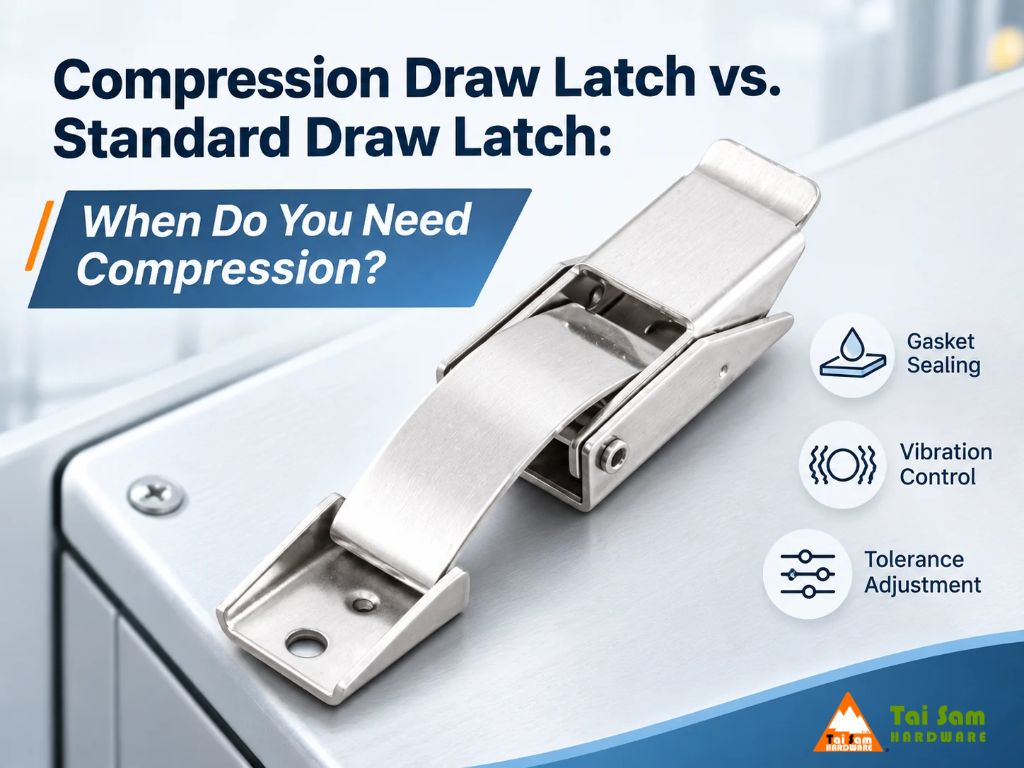
When designing industrial enclosures, machinery covers, and equipment access panels, choosing a draw latch involves more than keeping two components closed. The latch must also accommodate the door structure, operating conditions, and any sealing requirements.
A standard draw latch may be sufficient for general fastening applications. However, when an enclosure requires controlled gasket compression, reduced panel movement, or a more consistent closing force, a compression draw latch may be worth considering.
The key question is not whether a compression draw latch is always better, but whether the enclosure actually needs compression to function correctly.
At Tai Sam Hardware Corporation, we offer different draw latch configurations, including compression, spring-loaded, over-center, and adjustable types. This guide explains how to distinguish their functions, what to check before selecting a latch, and how to avoid common enclosure design problems.
1. What Is the Difference Between a Compression Draw Latch and a Standard Draw Latch?
A standard draw latch connects two components using a hook, catch, or similar fastening mechanism. Operating the lever draws the components together and keeps the door, cover, or panel closed.
A compression draw latch is designed to apply or maintain a closing force across the joined components. Depending on the design, it may use spring-loaded elements or a mechanism that accommodates a defined amount of movement while maintaining tension.
The distinction is important because not every draw latch provides the same compression characteristics.
How Does a Standard Draw Latch Work?
A conventional draw latch typically uses a lever mechanism to engage a keeper mounted on the opposite component.
Closing the lever creates tension between the latch and keeper. This makes standard draw latches useful for applications where convenient access and secure fastening are the main requirements.
Some standard or adjustable draw latches can also generate substantial closing force. Therefore, the term standard does not mean that a latch cannot compress a gasket.
How Does a Compression Draw Latch Work?
Compression draw latches are intended for applications where maintaining a suitable closing force or accommodating compression-related movement is particularly important.
Depending on the model, the latch may incorporate a spring element or other mechanical arrangement that helps maintain tension as the door, gasket, or surrounding structure moves within its designed operating range.
However, a compression draw latch does not automatically provide a specified compression distance, constant force, or sealing performance. Those characteristics must be verified for the individual product.
Key Takeaway: Standard draw latches primarily provide fastening, while compression-oriented designs place additional emphasis on maintaining an appropriate closing force. The actual difference depends on the mechanism and product specifications.
2. When Does an Industrial Enclosure Need Compression?
Compression becomes important when simply holding a door closed is not enough to meet the enclosure's functional requirements.
2.1 When a Gasket Must Be Compressed
Industrial enclosures may use gaskets to help limit the entry of dust, moisture, or other contaminants.
A gasket generally needs an appropriate amount of compression to form an effective seal. Too little compression can leave gaps, while excessive compression may damage the gasket or make the latch difficult to operate.
The required compression should be determined from the gasket manufacturer's recommendations and the enclosure design.
2.2 When Door Rattling or Movement Is a Concern
Machinery vibration can cause small movements between a door and its frame, particularly when there is excessive clearance.
Maintaining appropriate closing tension may help reduce this movement. However, the latch must work together with suitable hinges, door stiffness, and contact surfaces.
For equipment with significant vibration, the complete enclosure assembly should be evaluated rather than relying solely on the latch.
2.3 When Manufacturing Tolerances Affect Closure
Small variations in panel dimensions, gasket thickness, and installation position can affect how consistently a door closes.
Certain spring-loaded or adjustable latch configurations may help accommodate these variations within their specified operating range.
They should not be used to compensate for major alignment errors or structural deformation.
2.4 When Repeated Access Is Required
Inspection covers and maintenance panels may be opened and closed frequently.
In these applications, the latch should provide repeatable operation without requiring excessive force or causing unnecessary gasket wear.
Key Takeaway: Compression is most relevant when the enclosure needs controlled contact pressure, gasket sealing, or consistent closing tension—not simply because the equipment is industrial.
3. Compression Draw Latch vs. Standard Draw Latch: Comparison
The following table helps engineers distinguish the selection priorities of different draw latch designs.
| Selection Factor | Standard Draw Latch | Compression Draw Latch |
|---|---|---|
| Primary purpose | Securely fastens two components | Fastens components while addressing closing tension or compression |
| Closing force | Depends on lever geometry and adjustment | Depends on the compression mechanism and its operating range |
| Gasket applications | Suitable when the required compression can be achieved | Worth considering when compression control or accommodation is important |
| Vibration conditions | Requires suitable retention and installation | May help maintain tension, depending on the design |
| Panel tolerance | Depends on latch geometry | Some designs accommodate limited movement or variation |
| Typical applications | Covers, access doors, equipment cases | Gasketed covers, machinery panels, equipment enclosures |
| Key specification | Dimensions, keeper engagement, holding force | Dimensions, keeper engagement, compression characteristics, operating force |
A compression draw latch is not automatically more secure or suitable for higher loads than a standard draw latch. Both must be evaluated against their actual mechanical specifications.
4. Five Factors to Check Before Choosing a Compression Draw Latch
4.1 Required Gasket Compression
Before selecting a latch, determine whether the enclosure uses a gasket and how much compression the gasket requires.
Important measurements include the gasket's uncompressed thickness, target compressed thickness, and allowable compression range.
For example, if a gasket is 5 mm thick and its specified target compression is 20%, the nominal compressed thickness would be 4 mm. This is a calculation example, not a universal recommendation for gasket compression.
The latch arrangement must be capable of achieving the required door position without exceeding the gasket's operating limits.
4.2 Closing Force and Latch Capacity
The required closing force depends on gasket stiffness, gasket length, panel geometry, and the number and position of latches.
A larger enclosure may require multiple locking points to distribute compression more evenly.
Engineers should not assume that a product described as a compression latch has a higher rated holding force than another draw latch.
Where force ratings are not published, request technical information or evaluate a sample under representative conditions.
4.3 Mounting Dimensions and Keeper Position
A latch may have suitable materials and an appropriate mechanism but still perform poorly if the installation geometry is incorrect.
Confirm the mounting-hole positions, latch-to-keeper distance, operating clearance, and the relative height of the door and frame.
The keeper must be positioned so the latch reaches its intended closed position without excessive force or incomplete engagement.
4.4 Material and Environmental Conditions
Industrial draw latches may be exposed to moisture, cleaning agents, or corrosive environments.
Stainless steel is often considered where corrosion resistance is important, but the exact grade, surface treatment, and compatibility with the operating environment should be checked.
Material selection and sealing performance are separate considerations. A stainless steel latch does not automatically make an enclosure waterproof.
4.5 Opening Frequency and Maintenance
Repeated opening and closing can affect latch components, mounting hardware, and gaskets.
For frequently accessed equipment, engineers should consider operating effort, accessibility, wear, and the ability to inspect or replace components.
A suitable latch should be convenient to operate while maintaining the required closure condition throughout its expected service life.
Key Takeaway: Select a compression draw latch according to actual compression requirements, force, mounting geometry, material, and operating frequency—not its product name alone.
5. Common Mistakes When Selecting Draw Latches for Gasketed Enclosures
Mistake 1: Assuming Every Compression Latch Provides a Fixed Compression Distance
Different compression latch designs use different mechanisms. Some provide spring-loaded tension, while others may have a defined closing movement.
Always check the product drawing and operating specifications before assigning a compression distance to a particular model.
Mistake 2: Using the Latch to Correct Poor Door Alignment
A latch should not be expected to compensate for excessive door deformation, incorrect hinge positioning, or major dimensional errors.
Correct the enclosure geometry before finalizing the locking hardware.
Mistake 3: Ignoring Gasket Requirements
Selecting a latch without understanding the gasket's compression characteristics can result in inadequate sealing or excessive closing force.
The gasket, door, frame, and latch should be considered together.
Mistake 4: Assuming Compression Guarantees Waterproofing
A compression latch can help establish the contact pressure needed for sealing, but the enclosure's actual protection depends on the complete assembly.
A particular IP rating should only be claimed when supported by appropriate testing or certification of the relevant configuration.
Mistake 5: Choosing a Spring-Loaded Latch Without Checking Its Travel and Force
Spring-loaded designs may accommodate limited movement, but their useful travel and operating force vary by model.
Confirm that the selected latch operates within its intended range in both new and worn-in conditions.
6. Compression Draw Latch Solutions from Tai Sam Hardware Corporation
Tai Sam Hardware Corporation offers a range of industrial draw latches for different fastening requirements.
Our product categories include Compression Draw Latch / Spring Loaded Draw Latch, Over-Center Series Draw Latch, and Adjustable Series Draw Latch. These are distinct configurations and should be evaluated according to the enclosure's actual needs.
6.1 Compression Draw Latch / Spring Loaded Draw Latch Series
This product category includes the TSL-3025 Stainless Steel Compression Draw Latch, TSL-A211B-1 Stainless Steel Compression Latch, and TSL-605 Stainless Steel Spring Loaded Draw Latch, among other models.
The listed models feature stainless steel 304 main bodies with vibration-ground surface finishes. Specific spring characteristics, compression travel, and load ratings should be confirmed individually rather than assumed across the series.
Explore Compression Draw Latches and Spring Loaded Draw Latches »
6.2 Over-Center Series Draw Latch
For applications where conventional lever-operated fastening is sufficient, the Over-Center Series offers an alternative.
The category includes the TSL-001 Stainless Steel Over-Center Draw Latch, listed with a stainless steel 304 main body and vibration-ground finish.
Over-center designs should be selected according to the required engagement, installation dimensions, and holding performance.
Explore Over-Center Draw Latches »
6.3 Adjustable Series Draw Latch
When the main requirement is to adjust the latch-to-keeper engagement distance, an adjustable draw latch may be more appropriate.
For example, the TSL-280 Adjustable Series Draw Latch has a Y-type spiral adjustment mechanism that allows the engagement distance to be changed. The product is offered with steel and stainless steel 304 material options.
Adjustment can help establish the intended closing condition, but it does not mean the latch provides automatic spring compensation.
View TSL-280 Adjustable Series Draw Latch »
What Should OEM Buyers Provide When Requesting a Latch?
To identify a suitable draw latch, prepare the enclosure drawings, mounting dimensions, keeper position, gasket specifications, required closing force, environmental conditions, and expected opening frequency.
If vibration or shock is present, describe the operating conditions and any relevant performance requirements.
These details help determine whether a compression, spring-loaded, over-center, or adjustable draw latch is appropriate.
Explore our Draw Latches product range or contact Tai Sam Hardware Corporation for product selection assistance.
7. Frequently Asked Questions
Can an Adjustable Draw Latch Replace a Compression Draw Latch?
Sometimes, but the two designs should not be considered interchangeable.
An adjustable draw latch allows the user to modify the engagement distance or closing tension. A compression or spring-loaded draw latch may incorporate features intended to maintain closing force or accommodate limited movement.
If the enclosure requires compensation for gasket thickness changes or movement during operation, engineers should compare the mechanisms and specifications before selecting a replacement.
Does a Compression Draw Latch Guarantee an IP-Rated Seal?
No. A compression draw latch can contribute to the closing force needed for a gasketed enclosure, but it does not independently establish an IP rating.
Sealing performance also depends on gasket material, compression uniformity, door stiffness, hinge positioning, mounting details, and the overall enclosure design.
Where a specific IP rating is required, the complete enclosure configuration should be appropriately tested.
8. Conclusion: Choose Compression Based on the Enclosure's Requirements
A compression draw latch is worth considering when an industrial enclosure requires more than basic fastening—particularly when gasket compression, consistent closing tension, or limited movement accommodation is important.
However, a standard or adjustable draw latch may be sufficient when the primary requirement is to hold a cover or access panel securely closed.
The most reliable selection process begins with the enclosure design. Engineers should confirm the required closing force, gasket characteristics, mounting geometry, environmental conditions, and maintenance needs before choosing a latch.
At Tai Sam Hardware Corporation, we offer different draw latch configurations to support industrial equipment and enclosure applications.
Need Help Selecting the Right Draw Latch?
Share your enclosure design, gasket requirements, and installation conditions with our team. We can help you evaluate suitable fastening hardware for your application.


