
RELEASE DATE - 2026.08.19
Hinges may appear to be a relatively simple component in an industrial enclosure, but their design can directly affect door movement, equipment accessibility, exterior appearance, installation space, and long-term maintenance.
One of the first decisions engineers face is whether to use concealed hinges or exposed hinges. Concealed hinges are installed so that most or all of the hinge mechanism remains hidden when the door is closed, while exposed hinges remain visible on the exterior of the enclosure. Each design has advantages, and neither is automatically the right choice for every application.
For industrial enclosures, electrical cabinets, semiconductor equipment, network server systems, energy storage equipment, and machinery, the decision should be based on more than appearance. Door dimensions, opening angle, maintenance access, operating environment, installation method, and security requirements all need to be considered.
At TAI SAM HARDWARE CO., LTD., we provide industrial hardware solutions for cabinets, semiconductor equipment, machinery, and other equipment applications. This guide compares concealed and exposed hinges from an engineering perspective to help equipment designers and buyers determine which structure better fits their enclosure.
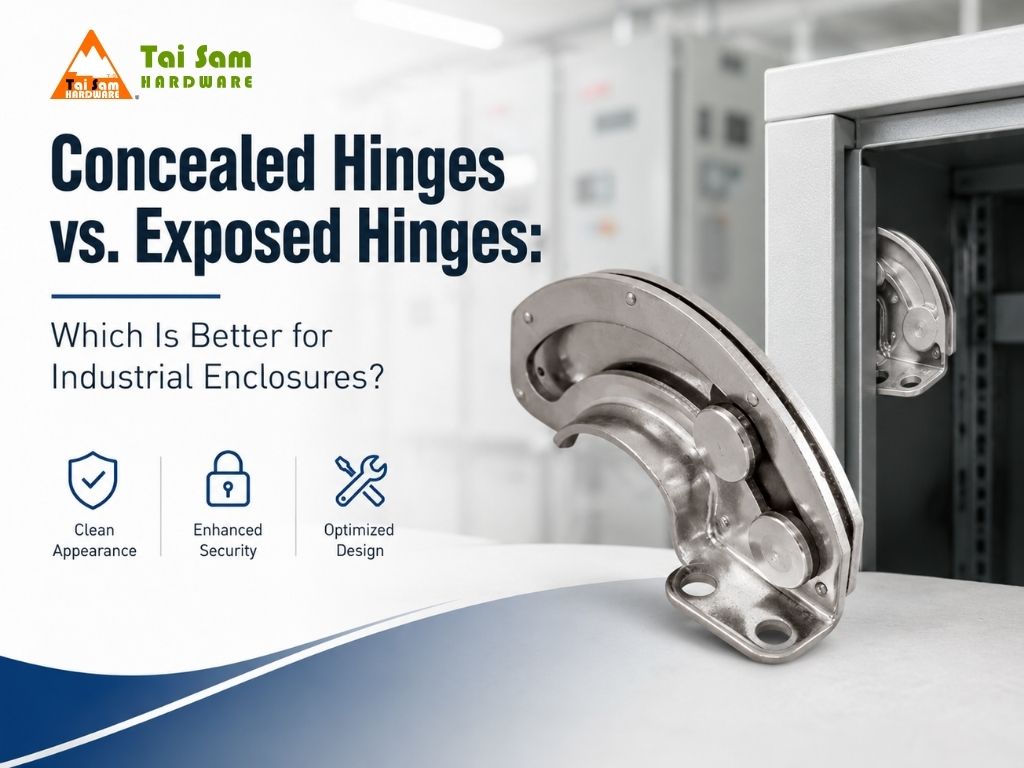
A concealed hinge is designed so that the hinge mechanism is positioned inside or behind the enclosure door and frame when the door is closed. This creates a cleaner exterior because there is little or no hinge hardware projecting from the outside surface.
For industrial equipment, the value of this design goes beyond aesthetics. Moving the hinge structure away from the exterior can reduce exposure to accidental impact and make the hardware less directly accessible from outside the enclosure.
Concealed hinges are particularly suitable for machine enclosures, electrical cabinets, control boxes, server systems, and other equipment where a clean exterior and protected hardware arrangement are important.
However, concealed installation also means engineers must carefully evaluate internal mounting space and the movement path of the door before finalizing the enclosure design.
An exposed hinge is installed with all or part of the hinge body visible when the enclosure door is closed. This is a traditional and widely used structure for industrial cabinets, machinery doors, access panels, and other equipment.
Because the hinge is mounted in an accessible position, exposed designs can simplify installation, inspection, replacement, and maintenance. Depending on the hinge type, they may also provide greater flexibility when working with large doors or enclosure structures where internal mounting space is limited.
The trade-off is that the hinge becomes part of the enclosure exterior. It may therefore be more exposed to impact, contamination, environmental conditions, or unauthorized access, depending on the equipment design.
For this reason, the choice between concealed and exposed hinges should begin with the enclosure's functional requirements rather than appearance alone.
| Comparison Factor | Concealed Hinges | Exposed Hinges |
|---|---|---|
| Hinge Visibility | Hidden or minimally visible when closed | Visible from the exterior |
| Exterior Appearance | Clean and streamlined | Traditional industrial appearance |
| External Hardware Projection | Reduced | Usually greater |
| Protection from External Impact | Hinge mechanism is less exposed | Hinge is directly exposed |
| Installation Space | Requires sufficient internal clearance | Often more flexible |
| Installation Access | Requires more planning | Generally straightforward |
| Maintenance Access | May be less direct | Usually easier to access |
| Door Opening Geometry | Strongly dependent on hinge and enclosure design | Often easier to accommodate |
| Security Consideration | Hardware is less accessible from outside | External hinge components may be accessible |
| Typical Design Priority | Clean, protected enclosure design | Simple installation and accessible maintenance |
The important point is that concealed hinges are not simply upgraded exposed hinges. They represent a different enclosure design approach, with different requirements for mounting, clearance, door movement, and serviceability.
One of the clearest advantages of concealed hinges is the ability to maintain a cleaner enclosure surface.
Industrial equipment increasingly needs to combine functionality with professional appearance, particularly for control cabinets, automation equipment, network systems, energy storage equipment, and machinery installed in customer-facing environments. Large external hinge components can interrupt an otherwise streamlined sheet-metal design.
By positioning the hinge mechanism internally, concealed hinges allow designers to reduce visible hardware on the exterior.
A cleaner exterior can also reduce protruding components that could interfere with adjacent equipment, cables, operators, or narrow installation spaces. This makes concealed hinges especially relevant when the enclosure itself forms an important part of the overall equipment design.
For some industrial enclosures, hinge positioning also becomes part of the security strategy.
When hinge components are mounted externally, parts of the mechanism may be physically accessible from outside the cabinet. A concealed hinge places the functional hinge structure behind the closed door, making direct external access more difficult.
This can be valuable for electrical cabinets, control systems, server equipment, energy infrastructure, and other enclosures where designers want to minimize externally accessible hardware.
However, a concealed hinge should not be treated as a complete security system by itself. Overall enclosure security still depends on the door structure, locks, latches, frame, fasteners, and access-control design.
The hinge should therefore be evaluated as one element of the complete enclosure protection strategy.
Industrial equipment is frequently installed in environments where doors and external hardware can be exposed to carts, tools, moving equipment, maintenance operations, or accidental contact.
An externally mounted hinge becomes one of the projecting components that may receive this impact.
With a concealed hinge, the hinge mechanism is protected behind the door and frame when the enclosure is closed. This reduces direct exposure and can help protect the hinge mechanism in applications where external contact is a concern.
This does not mean that every concealed hinge is automatically more durable. Actual durability still depends on hinge material, load capacity, mounting structure, door weight, installation accuracy, and operating conditions.
The key advantage is reduced external exposure, rather than an assumption that all concealed hinges are inherently stronger.
Concealed hinges provide clear design advantages, but exposed hinges remain valuable because of their accessibility.
An exposed hinge is generally easier to inspect, fasten, adjust, and replace. Maintenance personnel can access the hinge without working within a restricted internal enclosure space.
This can be particularly valuable for machinery requiring frequent servicing or for enclosure designs where reducing maintenance time is more important than maintaining a completely flush exterior.
Removable or lift-off hinge designs can further simplify service access by allowing the entire door to be removed when necessary.
Therefore, if rapid door removal or frequent hinge servicing is a major requirement, an exposed or removable hinge configuration may offer practical advantages over a concealed design.
One of the most important engineering considerations for concealed hinges is internal clearance.
Because the hinge mechanism operates inside the enclosure, engineers need to consider not only whether the hinge physically fits, but also how it moves throughout the door's opening range.
Potential interference may come from internal frames, mounting rails, electrical components, wiring, sealing structures, or other enclosure hardware.
This becomes particularly important in compact electrical cabinets and densely packaged industrial equipment.
A concealed hinge selected late in the enclosure design process may force unnecessary structural modifications. Hinge geometry should therefore ideally be considered during the initial sheet-metal and door-layout stage rather than after the enclosure structure has already been finalized.
A common selection mistake is choosing a hinge based on appearance and external dimensions without considering how far the door actually needs to open.
Some equipment only requires enough opening for routine inspection. Other systems require wide access so technicians can replace components, service internal assemblies, or work beside the open door.
The hinge structure, enclosure geometry, door thickness, and surrounding components can all affect the usable opening angle.
A wider opening angle can be particularly valuable when technicians need unobstructed access to internal equipment. Some concealed hinge configurations can support wide opening angles, including designs intended for approximately 180-degree opening, but this capability must always be verified according to the actual product and enclosure geometry.
The required maintenance opening should therefore be defined before the hinge is selected.
Whether a hinge is concealed or exposed does not by itself determine its corrosion resistance.
Material and surface treatment remain critical.
Equipment operating outdoors, in humid environments, near coastal areas, or under demanding industrial conditions may require stainless steel or another suitable corrosion-resistant material.
A concealed hinge benefits from reduced direct exposure, but moisture and contaminants may still enter the enclosure environment. Conversely, an exposed hinge can perform reliably under harsh conditions when its material and surface treatment are correctly selected.
Industrial hinge options may include stainless steel, steel, zinc alloy, aluminum alloy, and engineering plastics, depending on the specific product design.
Engineers should therefore evaluate hinge configuration and hinge material as two separate decisions rather than assuming that a concealed design automatically provides better environmental resistance.
The answer depends on what the enclosure needs to accomplish.
Choose concealed hinges when the project prioritizes a clean exterior, reduced external hardware, less direct access to hinge components, or protection of the hinge mechanism from external contact.
Choose exposed hinges when straightforward installation, easy inspection, maintenance accessibility, or rapid door removal is more important.
| Application Priority | Recommended Direction |
|---|---|
| Clean, flush exterior | Concealed Hinge |
| Reduced externally accessible hardware | Concealed Hinge |
| Reduced hinge exposure to accidental impact | Concealed Hinge |
| Limited internal mounting space | Exposed Hinge |
| Frequent hinge maintenance | Exposed Hinge |
| Quick door removal | Removable / Lift-Off Hinge |
| Wide service access | Evaluate actual opening geometry |
| Corrosive environment | Select appropriate material regardless of hinge style |
Rather than asking which hinge is universally better, engineers should ask:
Which hinge structure better supports the enclosure's door movement, installation space, maintenance strategy, security requirements, and operating environment?
That question produces a more reliable engineering decision.
Once concealed hinges have been identified as the preferred solution, the next step is selecting a configuration that matches the actual enclosure.
Start with the door itself. Its dimensions, weight, thickness, center of gravity, and required opening angle influence hinge selection. Next, evaluate the available internal mounting space and determine whether hinge movement could interfere with the enclosure frame or internal equipment.
The operating environment should then determine material requirements. Corrosion exposure, moisture, cleaning procedures, and expected service life can all influence the appropriate material and surface treatment.
Finally, engineers should review installation dimensions and mounting geometry against actual product drawings rather than selecting solely from overall hinge dimensions.
This design-first approach helps prevent insufficient opening, door interference, excessive hinge loading, difficult installation, and premature wear.
Concealed hinges are particularly relevant to equipment where enclosure design, component protection, and service accessibility need to work together.
Semiconductor machinery, automation systems, electrical control equipment, and precision industrial equipment often contain densely arranged internal components. A hinge must therefore allow sufficient service access without interfering with internal mechanisms, cables, or structural members.
At the same time, reducing exterior projections can help maintain a cleaner equipment profile and minimize exposed hardware around operators and adjacent machinery.
This illustrates why concealed hinge selection should begin with application requirements instead of simply choosing a hinge because it is hidden.
At TAI SAM HARDWARE CO., LTD., we provide industrial hardware solutions for equipment manufacturers across a variety of applications, including cabinets, machinery, semiconductor equipment, and industrial enclosures.
For concealed hinge projects, the hinge should be evaluated together with door dimensions, mounting arrangement, material requirements, opening geometry, and the surrounding enclosure structure.
When requesting a hinge recommendation or discussing an OEM project, providing complete application information can make product evaluation more accurate. Useful information includes door dimensions, expected load, required opening angle, internal installation space, preferred material, operating environment, and mounting method.
This allows the hinge to be considered as part of the complete enclosure design rather than as an isolated hardware component.
No. Concealed hinges are particularly useful when clean exterior design, reduced external hardware, and protected hinge placement are important. Exposed hinges may be more appropriate when easy installation, maintenance accessibility, or limited internal space is the priority.
Some concealed hinge and enclosure configurations can support wide opening angles, including approximately 180-degree designs. However, the actual opening angle depends on the specific hinge geometry, mounting arrangement, door thickness, and enclosure structure.
Engineers should provide door dimensions and weight, required opening angle, internal mounting clearance, mounting method, operating environment, material requirements, and ideally drawings of the door and frame.
OEM projects may require different dimensions, materials, mounting structures, or other project-specific characteristics. Providing complete enclosure drawings and application requirements helps determine whether an existing hinge or a customized solution is more appropriate.
Learn how to evaluate holding force, vibration conditions, sealing requirements, materials, and mounting design when selecting a draw latch for industrial enclosures and machinery.
Explore how draw latches help maintain clamping force, reduce panel movement, support gasket compression, and improve equipment reliability under continuous vibration.
Understand the key engineering factors behind custom cam locks, including panel thickness, grip range, materials, key systems, mounting methods, environmental protection, and OEM integration.
There is no universal winner in the comparison between concealed hinges and exposed hinges.
Concealed hinges are particularly valuable when industrial enclosures require a clean exterior, reduced external hardware exposure, and a hinge mechanism that remains protected behind the closed door. Exposed hinges remain an effective solution when accessibility, straightforward installation, frequent maintenance, or removable-door functionality is more important.
The correct decision should therefore consider the entire enclosure system: door size and weight, opening angle, internal clearance, installation method, operating environment, maintenance requirements, and security expectations.
By defining these requirements before selecting the hinge, equipment manufacturers can avoid interference problems, improve service accessibility, and create a more reliable enclosure design.
TAI SAM HARDWARE CO., LTD. provides industrial hinge and concealed hinge solutions for equipment manufacturers and supports OEM requirements. For new equipment or enclosure projects, providing drawings and operating requirements can help identify a hinge configuration that better matches the actual application.



This site uses cookies to improve your browsing experience. we’ll assume you’re OK to continue. If you want to read more about this, please click PRIVACY thank you.